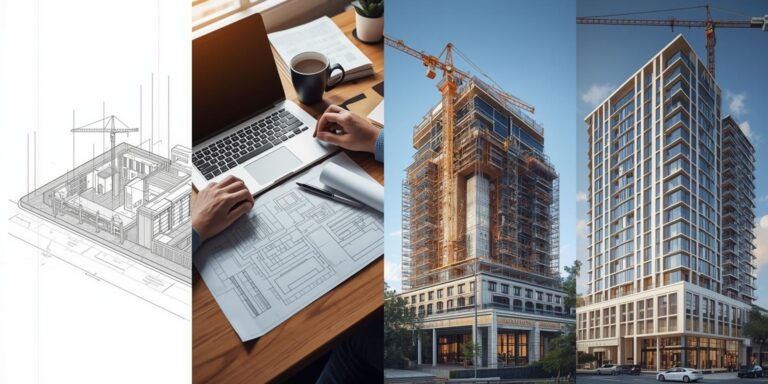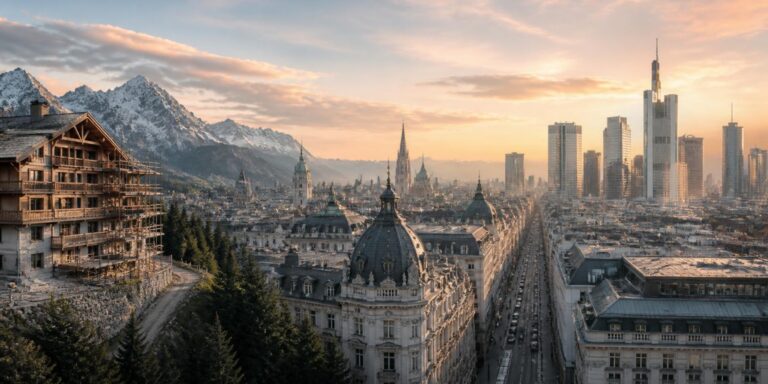


Ask someone to picture a groundbreaking for a hotel project, and they’ll likely imagine a crane and an empty lot. But a growing number of hotel projects under construction in the DACH region skip the empty lot entirely. Instead, they start with a building that already exists: an old office block, a former retail space, an outlet that’s been dormant for years, or a landmark overdue for a new life.
The THP hotel database shows over 250 in-progress hotel projects across Germany, Austria, and Switzerland currently classified as refurbishments or conversions. This is a meaningful chunk of the region’s active pipeline, and it offers a good at how developers are approaching new hotel projects.
Why Convert Instead of Build?
A few practical reasons explain the shift. Prime locations in major German-speaking cities are becoming harder to find. Land price always seems to be increasing, permitting takes ages, and even construction costs have climbed in recent years. An existing building, especially one already zoned for commercial use, avoids a lot of these issues.
The DACH region’s hotel market illustrates this well. Reporting on the market in 2026 describes it as one shaped by selective growth, conversions, and operational precision, making it one of the most active hotel construction markets in Europe. Conversions make up a real share of that pipeline, helping the market expand even as available space grows tighter.
There’s also a design angle. Office buildings tend to have large floor plans and central locations, both useful for hotel developers looking to skip years of site assembly. Even more, retail buildings, which have really been hit hard by the shift to e-commerce, often come with ground-floor space suited to a lobby or event room.
What This Looks Like on the Ground
Here are a few examples. In Berlin, the Clayton Hotel Tiergarten is coming together inside what used to be the Novotel Berlin Am Tiergarten. The 274-room property is undergoing a full refurbishment, set to open in Q4 2026 with a restaurant, bar, meeting and events center, sauna, steam room, and gym. It’s also part of a larger development called Tiergarten Tower, which combines office and hotel space, a sign that conversions and mixed-use projects often go together.
Salzburg offers a different kind of example. The Kimpton Hotel Salzburg is being built inside the former AVA Hof on Ferdinand-Hanusch-Platz, turning a historic courtyard into a 119-room, 5-star property with rooms and suites up to 65 square meters, along with a restaurant, bar, wellness and fitness areas, and modern meeting spaces. The surrounding redevelopment covers around 16,300 square meters and includes retail, office space, apartments, conference areas, and underground parking. It’s set to open in 2028.
These two projects show adaptive reuse working at different scales and in different markets. Both represent real commitments to reusing existing buildings rather than starting from an empty lot, even as their surrounding developments take very different shapes.
What It Means for the Rest of the Pipeline
None of this means, of course, that new-build construction is going away, as plenty of ground-up projects are still moving through the DACH and global pipeline. But hotel conversions have moved past being a side note that occasionally happen. With over 250 refurbishment and conversion projects currently in progress across the region (and this number is always going up in the database), developers appear to be leaning on this strategy on purpose.
For hotel suppliers, architects, and hospitality watchers, the trend is worth tracking. A conversion project follows a different rhythm than a new-build, with its own timelines, design constraints, special requirements, and opportunities. As adaptive reuse continues to show up across DACH’s hotel pipeline, it’s influencing both the location of new hotels and the approach developers take to build them.
So, back to the original question: Is adaptive reuse the future of hotel development in DACH? Not entirely, no. New-build projects will keep moving through the pipeline—and they have their own list of great benefits. But reuse has earned a permanent place in the pipeline, and that shift alone is worth watching.