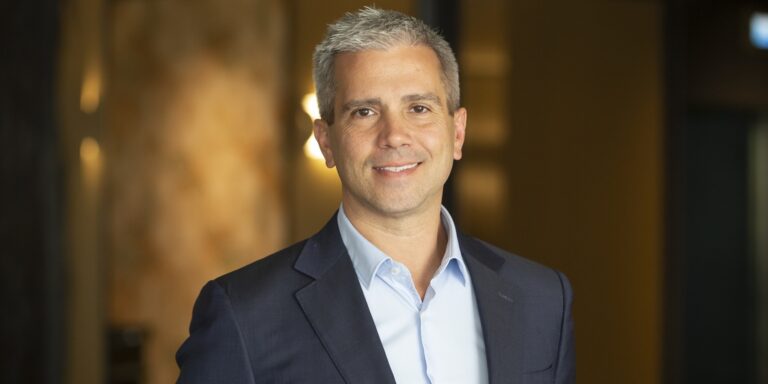


Chris Meyers is the Principal Architect and Owner of Meyers+Associates, and one of a small number of architects trusted as a preferred design vendor by both Marriott and Hilton. That’s no small feat—the two brands are direct competitors, each with its own standards, and each determined to make sure a hotel bearing its name never gets confused with anyone else’s. Meyers has spent his career learning to work fluently within both systems, a balancing act that comes up throughout the conversation below.
Over the course of his career, Meyers and his firm have designed more than 100 hotels across the United States, from ground-up builds to complex adaptive reuse projects. One recent example is the AC Hotel in Downtown Columbus, Ohio, which was the kind of project where brand standards, structural realities, and design creativity all had to come together at once.
We had the chance to talk with Meyers, and in his responses below, he talks about what it actually takes to stay on-brand across dozens of cities without ever repeating himself, how he navigates the line between a brand’s non-negotiables and a building’s constraints, and where he sees room for change in hospitality design—from wasteful key cards to the underrated importance of staff spaces. He also shares his take on where hotel design is headed next, including the rise of dual-brand projects and a growing case for sustainable, adaptive reuse.
You’re a preferred vendor for both Marriott and Hilton—two companies that are direct competitors and work hard to keep their brand identities distinct. How did you end up on both lists?
Both brands have unique evaluation procedures. We had a lot of early success in hospitality, demonstrating creativity in design solutions, very high-quality construction documents, and a comprehensive understanding of each brand’s objectives. Early on, being recognized as Marriott’s Architect of the Year boosted our positioning in the industry. Developing great relationships in hospitality organizations also helped, as people prefer to work with those they get along with.
As a follow-up to the first question, how do you keep Marriott’s standards and Hilton’s standards from bleeding into each other on a project?
We have a very well-trained staff that prioritizes design objectives; both brands have standards, not mandates. They allow design professionals to work within the brand identity and offer creative solutions that are evaluated and implemented. Both brands have exceptionally talented in-house design teams that we collaborate with to find the best solutions for every project.
When a brand standard and the physical reality of a building conflict, what happens next? Do you go back to the brand for an exception, or does the design have to bend?
Design in hospitality is a collaborative process. On the brand side, they recognize that sometimes situations require alternative approaches, and we, as designers, often propose them. Given our relationship with the brands, the designs we propose often become the next standard. We carry very little ego in our work, which is somewhat rare in our profession. Working with the brands to meet their objectives with creative solutions has been the root of our success.
You’ve done more than 100 hotels. Is there a version of “the Chris Meyers house style” that shows up no matter what brand you’re working with?
No, not at all. I design a lot of different building types, and one thing I have always believed is that building design is not just me—it is the collaboration of a team and what is right for the site and needs of the project. If you lined up all of my buildings, you would not find a signature style, but I hope you would find consistency in quality, honest materiality, relationship to contextual conditions, and a successful solution to what the project is trying to accomplish.
Adaptive reuse projects—such as the AC Hotel in Columbus that you worked on—start with a building that was never meant to be a hotel. What’s the first thing you’re checking to know whether a structure like that is actually workable?
The biggest challenge in adaptive reuse is the modularity and dimensional constraints of a guest room tower: efficiency, structural systems, and utility stacking are pretty important to a hotel’s economics. Sometimes creativity is deeply necessary to get a conversion project to work. Those become some of the most challenging and rewarding projects.
We are big proponents of sustainability. I always say “the greenest building is an existing one” because we can create great solutions that work with buildings of character and viability, making interesting projects.
How do you make sure a hotel reads unmistakably as an AC—or a Marriott, or a Hilton—no matter what city it’s in, without every property ending up as a copy–paste of the last one?
The answer is not to match the others; it is to rely on what we call design pillars. These are guideposts that shape the consistency of the place’s overall feeling. This is accomplished with subtle consistency, materiality, and brand identity elements.
As I previously indicated, I am very much a context-driven designer. The site and conditions of the city, property, or neighborhood really drive the evolution of the design. Our buildings aim to exemplify the context through precedent, form-relationship, materiality, historical analysis, and local identity. These shape a design solution that, along with the brand pillars, guides a design that is unique to that location yet consistent with the brand design requirements.
If you could get one brand standard changed, something you think exists for a reason that no longer holds up, what would it be?
Key cards. The amount of waste created by key cards and the paper sleeves they come in seems unnecessary to me, and it often ends up in the trash after an overnight stay. Many people get multiple keys for no reason. Technology with room access controls is available and really should become a standard in hospitality.
What’s changing right now in how hotels get designed and built, and is there a trend you think most people in the industry are underestimating?
We are seeing a huge need for dual-brand projects, which offer a greater variety of room types, shared amenities, and shared back-of-house spaces for much improved efficiency and economic value. It has been our experience that dual brands create better economic viability for developers and greater appeal for guests.
Everyone pays close attention to lobbies and rooftop bars. What’s the most underrated square footage in a hotel? The space nobody thinks about that you actually care a lot about?
From a guest perspective, it’s social work environments and options for small group meetings and discussions. From an operator’s perspective, it’s a proper support space for staff, with a break area, restrooms, lockers, and a lounge. Caring for staff is an important element in hospitality; their happiness leads to better service and a stronger impression of the hotel.
If you had to guess, what’s the one thing about hotel design that guests notice and love but have absolutely no idea an architect was responsible for?
Acoustical performance. We use advanced acoustical engineering and several key acoustical techniques in our projects that greatly improve the STC (Sound Transmission Class). Guest satisfaction is heavily influenced by limiting audible disturbance, and we pay close attention to it.